
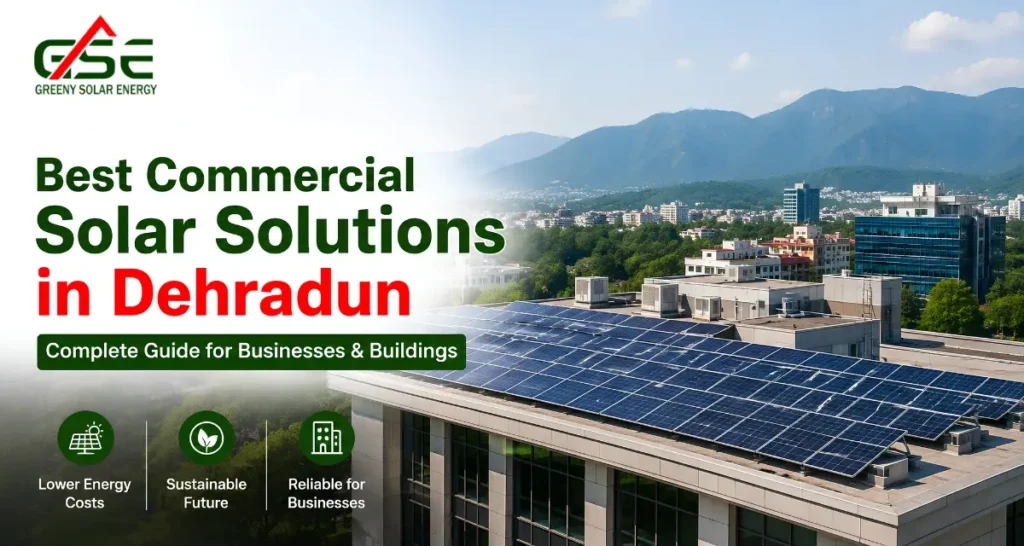
Ask any hotel manager on the Mussoorie road or a factory owner in Selaqui what their third-largest operating expense is, and electricity usually makes the list without much hesitation. Commercial and industrial tariffs in Uttarakhand sit far above what households pay, and they come loaded with fixed demand charges, peak-hour surcharges and the occasional revision that nobody budgeted for. Unlike raw material costs, this is one expense a business can partly take off the market and put on its own roof.
That is the practical case for solar in Dehradun — not sustainability slogans, but a 25-year asset that replaces a recurring bill. The Doon valley gets a workable amount of usable sunlight, most commercial buildings here have flat or lightly loaded rooftops doing nothing, and the regulatory framework for grid-connected commercial systems is settled enough to plan around.
This guide walks through what the best commercial solar solutions in Dehradun actually look like in practice: which system type suits which kind of business, what drives cost, how installation and net metering really work here, what savings depend on, and how to separate a competent installer from a cheap quotation. Greeny Solar Energy has put this together from field experience with commercial rooftops across Dehradun and the surrounding districts, so the emphasis is on what businesses ask before signing, not on brochure claims.
What Are Commercial Solar Solutions?
Commercial solar solutions are grid-connected or hybrid solar power systems designed for business premises — offices, hotels, factories, hospitals, schools, shops and warehouses. They are sized against the building’s actual electricity consumption and sanctioned load, installed mostly on rooftops, and used to offset expensive commercial-tariff power with self-generated electricity during the day.
The category covers a few distinct configurations:
- Rooftop commercial solar — the most common approach. Panels are mounted on an existing roof, so there is no land cost and generation happens right where consumption does.
- On-grid systems — connected to the UPCL supply through a net meter. No batteries; surplus goes to the grid and is credited against imports.
- Hybrid systems — solar plus battery storage, so critical loads keep running through an outage.
- Customised systems — larger or unusual installations combining shed roofs, canopies, carports and ground space, often with staged capacity for businesses that expect load growth.
The distinction matters more than it sounds. A school and a hospital of identical roof size need completely different systems, because one shuts down in summer and the other cannot afford to shut down at all.
That is the practical case for solar in Dehradun — not sustainability slogans, but a 25-year asset that replaces a recurring bill. The Doon valley gets a workable amount of usable sunlight, most commercial buildings here have flat or lightly loaded rooftops doing nothing, and the regulatory framework for grid-connected commercial systems is settled enough to plan around.
This guide walks through what the best commercial solar solutions in Dehradun actually look like in practice: which system type suits which kind of business, what drives cost, how installation and net metering really work here, what savings depend on, and how to separate a competent installer from a cheap quotation. Greeny Solar Energy has put this together from field experience with commercial rooftops across Dehradun and the surrounding districts, so the emphasis is on what businesses ask before signing, not on brochure claims.
Why Businesses in Dehradun Should Invest in Commercial Solar
Commercial solar solutions in Dehradun make financial sense for a fairly specific reason: the tariff a business pays for grid power is high, while the cost of generating a unit on its own roof is fixed the day the system is commissioned.
The concrete benefits:
Lower monthly electricity bills. Every unit generated and consumed on site is a unit not purchased at commercial rates. For a daytime-heavy business, that offset is substantial and immediate.
Reduced dependence on grid supply. Solar does not eliminate the grid connection, but it reduces how much of the load rides on it — useful during load-heavy summer months when supply quality dips.
Predictable long-term energy costs. Tariffs revise upward over time. A solar plant’s cost per unit is decided once, at installation, and then falls in real terms every year the tariff rises.
Productive use of idle rooftop space. Warehouses, factory sheds and institutional buildings in Dehradun typically have far more roof area than they will ever need. Solar is one of the few ways to make that square footage generate revenue.
Credible sustainability performance. For hotels chasing green certifications, schools reporting to boards, and manufacturers under supplier ESG requirements, on-site generation is measurable and auditable — not a claim.
Better visibility into energy use. Any decent commercial system comes with monitoring. Most businesses discover consumption patterns they did not know they had within the first quarter.
Best Commercial Solar Solutions for Different Businesses
| Business Type | Suitable Solar Solution |
|---|---|
| Offices | Rooftop On-Grid |
| Hotels & Resorts | High-Capacity Rooftop / Hybrid |
| Schools & Colleges | Rooftop Solar (On-Grid) |
| Hospitals | Hybrid / Backup Solar |
| Factories | Industrial Rooftop Solar |
| Warehouses | Large Rooftop Solar |
| Shops & Restaurants | Small Commercial Rooftop |
Types of Commercial Solar Systems
On-Grid Solar System
The default choice for businesses that consume most of their power during daylight hours. Solar output feeds the building’s load first; anything extra is exported to the grid through a net meter and credited. There is no battery, which keeps capital cost down and maintenance minimal. The trade-off: during a grid outage, the system shuts down for safety and the building has no solar power until supply returns.
Hybrid Solar System
Solar with battery storage, sized so that essential loads — servers, cold storage, medical equipment, lifts, emergency lighting — continue running when the grid drops. Hospitals, data-dependent offices and hotels with guest-facing loads usually justify the extra cost. Batteries add meaningfully to project cost and need replacement well before the panels do, so they are worth adding for specific loads rather than for the whole building.
Off-Grid Solar System
Fully independent of the grid, with battery storage carrying the site through evenings and cloudy spells. In and around Dehradun, this is mostly relevant to sites with no reliable connection at all — remote resorts, hill properties, telecom or agricultural infrastructure. For a commercial building inside the city with a working UPCL connection, off-grid is rarely the economical answer.
Commercial Solar Installation in Dehradun: Step-by-Step Process
A commercial solar installation in Dehradun typically runs from initial assessment to commissioning over several weeks, with the DISCOM approval and metering stages accounting for a good share of that time. The sequence:
Step 1 — Electricity bill and load analysis
Twelve months of bills, not one. The installer needs to see sanctioned load, contract demand, monthly consumption, tariff category and any peak-hour or demand charges. Seasonal businesses show their real pattern only across a full year.
Step 2 — Site and rooftop assessment
A physical survey: usable area, roof type and structural condition, shading from water tanks, lift machine rooms, adjacent buildings, ridgelines and mature trees. Dehradun sites often lose more area to shading than owners expect, particularly on plots backing onto hillsides or dense tree cover.
Step 3 — System design and capacity sizing
Capacity is matched to consumption and sanctioned load, not to how many panels the roof could physically hold. Oversizing beyond what the connection permits creates approval problems; undersizing wastes the roof.
Step 4 — Component selection and quotation.
Modules, inverter configuration, mounting structure, cabling, protection devices and monitoring, with warranties specified in writing. This is the stage where quotations diverge most, and where they should be compared line by line rather than on the bottom figure.
Step 5 — Installation
Structure fabrication and anchoring, module mounting, DC and AC cabling, earthing and lightning protection, inverter and panel board installation. On occupied commercial premises, sequencing matters — a hotel in peak season and a school during vacations need very different work schedules.
Step 6 — Testing, commissioning and grid connection
Insulation and polarity checks, inverter configuration, safety verification, followed by the net metering application, DISCOM inspection and installation of the bidirectional meter. Documentation errors here are the most common cause of delay, so the paperwork should be handled by the installer, not the business.
Step 7 — Monitoring and maintenance
Generation monitoring goes live, and a cleaning and inspection schedule begins. This is where long-term yield is either protected or quietly lost.
How Much Does Commercial Solar Cost in Dehradun?
The cost of commercial solar in Dehradun depends mainly on system capacity, panel and inverter selection, rooftop conditions, mounting structure requirements and installation complexity. Per-kW cost generally falls as capacity rises, but roof type can reverse that — an elevated structure over a shed roof or a high-wind exposed site costs more per kW than a straightforward flat concrete terrace.
| System Size | Typically Suitable For | Cost |
|---|---|---|
| 10 kW | Small commercial property, shop, clinic | Get Quote |
| 25 kW | Medium business, office, school block | Get Quote |
| 50 kW | Hotel, large office, mid-size facility | Get Quote |
| 100 kW+ | Industrial unit, warehouse, large building | Custom Quote |
Two points on the financial side that businesses in Dehradun should be clear about before budgeting:
There is no central capital subsidy for commercial solar. PM Surya Ghar Muft Bijli Yojana applies to residential consumers. Commercial, industrial and most institutional installations do not receive that assistance, and any vendor promising a central rooftop subsidy on a commercial connection is misrepresenting the scheme.
Accelerated depreciation is the main tax incentive instead. Under Section 32 of the Income Tax Act, businesses that own their solar plant can claim accelerated depreciation on the asset, which materially improves the first-year position for a profitable company. Two conditions catch people out: the benefit is halved if the plant is put to use for less than half the financial year, so commissioning date affects the claim; and it is available only to the owner of the asset, which rules it out under RESCO or PPA models where a developer owns the system. Confirm the applicable rate and treatment with your CA before you build it into a payback calculation.
How Much Can a Business Save With Solar?
Commercial solar is a 25-year decision made on a two-week evaluation, so the selection criteria matter more than the discount. Six things to test:
Depth of site assessment. Did they visit, measure and check the roof structure, or did they quote from a Google Maps image and a phone call? A vendor who has not physically surveyed the site cannot have sized the system correctly.
Sizing logic they can defend. Ask why that capacity, and expect an answer referencing your consumption pattern, sanctioned load, available shade-free area and export expectations — not the maximum the roof could hold.
Component quality and compliance. Get exact make and model of modules and inverters in writing, with warranty terms. Grid-connected commercial projects also carry module-listing requirements under the MNRE’s ALMM framework, and the rules around domestically sourced cells have shifted more than once during 2026 — including a transition window for net-metering projects. Your installer should be able to tell you exactly which requirement applies to your project and confirm the current position, since it directly affects both approval and panel choice.
Installation and structural competence. Uttarakhand sits in a high seismic zone, and valley sites see significant wind loading during pre-monsoon and monsoon weather. Mounting structure design, foundation detailing, waterproofing at roof penetrations, cable routing and earthing are where poor installations reveal themselves — usually two monsoons later.
Warranty and after-sales structure. Separate the product warranty from the workmanship warranty and the performance warranty. Ask what response time is committed for a fault, and who physically attends the site. A supplier without a local service presence in Dehradun is a warranty on paper.
Monitoring and maintenance. Systems degrade quietly. Without generation monitoring, a business can lose 10–15% of output to soiling, a faulty string or a tripped inverter and not notice for months. Confirm what monitoring is provided and what a maintenance visit actually includes.
A business evaluating the best solar company in Uttarakhand should weigh these six factors together. The cheapest quotation is frequently the one that skipped the site survey, specified an undersized inverter, or has no service team within 200 kilometres.
Why Choose Greeny Solar Energy for Commercial Solar?
Greeny Solar Energy works with commercial and institutional clients across Dehradun and Uttarakhand, and the approach is deliberately consultative rather than catalogue-driven.
- Customised commercial system design — capacity and configuration built from your consumption data and load profile, not from a standard package.
- Professional site assessment — physical survey covering roof structure, shading, cable routing and electrical readiness before any quotation is issued.
- Quality components with documented specifications — make, model and warranty terms stated clearly, so you know exactly what is being installed.
- End-to-end installation support — design, supply, installation, testing and the net metering and DISCOM documentation handled together.
- System monitoring — generation visibility from day one, so underperformance is caught early rather than discovered on a bill.
- After-sales service — a local team for maintenance, cleaning schedules and fault response.
If you are evaluating solar for a commercial property, the useful first step is a bill and site review. That conversation should tell you whether the project makes sense for your building before anyone discusses equipment.
Frequently Asked Questions
Considering solar for your commercial property in Dehradun? Share your last twelve months of electricity bills and rooftop details with Greeny Solar Energy for a site assessment and a system proposal built around your actual consumption.